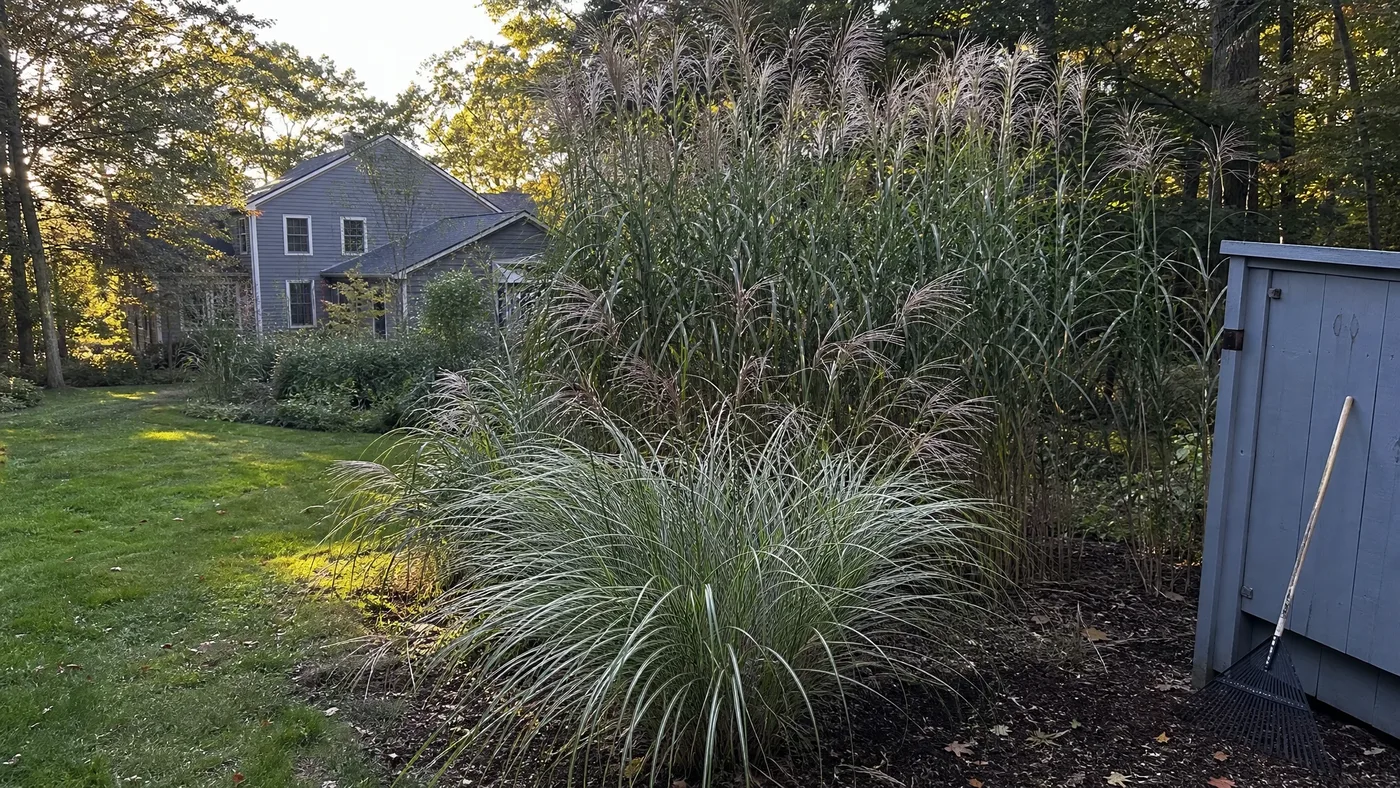
Giant Miscanthus vs Chinese Silver Grass: Know the Difference
If your order confirmation says 12 feet and you were expecting a grass for the front bed, take a breath. This is one of the most common mix-ups we hear about, and it is easy to sort out before anything ships. This season we noticed a run of customers who typed "giant Chinese silver grass" into a search box and landed on a tall biomass crop instead of the ornamental they pictured.
The two plants share a genus and a lot of vocabulary, so the confusion is understandable. They are not the same plant, and they do not behave the same way in a yard.
This guide covers everything you need to know about telling them apart, from the height gap and the hybrid's parentage to reading a plant tag, matching each plant to its site and fixing an order that has already gone wrong.
A Towering Crop Next to Garden-Sized Chinese Silver Grass
Start with the numbers, because height is the first thing that shows up on a confirmation email and the clearest difference between these two plants.
Giant Miscanthus Is Built for Bulk
Giant miscanthus, written Miscanthus x giganteus, is grown as an energy crop, and everything about it is chosen for tonnage rather than looks.
Penn State Extension says the plant reaches heights of up to 12 feet, and listings for it often quote 10 to 14 feet. That is taller than most fences and plenty of porch roofs. It is planted from rhizomes, which are pieces of root, and the usual setting is a field where the whole point is a dense stand of tall stems.
'Gracillimus' Is Sized for a Bed
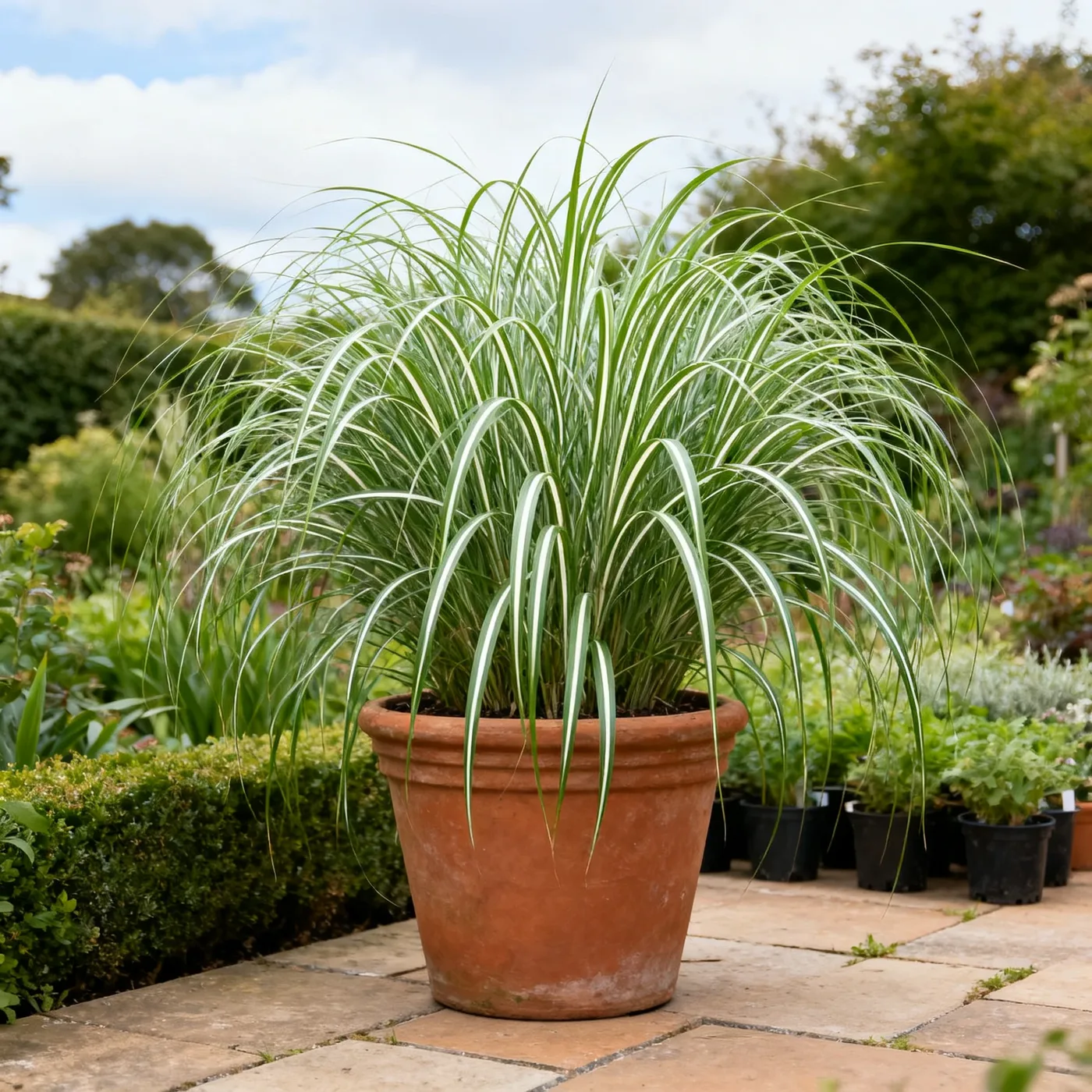
Chinese Silver Grass, Miscanthus sinensis 'Gracillimus', is an ornamental cultivar, and it is the plant most home gardeners picture when they hear "silver grass."
UF/IFAS lists it at 5 to 6 feet tall with a spread of 5 to 10 feet. Its leaves are fine and narrow, and it bears pink flowers in late summer and fall. You get a fountain of foliage you can see over, not a wall you have to look up at.
If you want the full growth story for the garden plant, our guide on how big Chinese Silver Grass gets covers rate and size year by year.
What the Gap Means in Practice
A height difference of five feet or more sounds abstract until you picture it against your own house, so here is how it plays out.
A 'Gracillimus' behind a bench frames the seat. A giant miscanthus in the same spot shades it, blocks the view and leaves you with a project instead of a plant. Neither is a bad plant. They are simply two different jobs, and the trouble only starts when one arrives in the other's place.
Why Chinese Silver Grass Is Not Giant Miscanthus
The names overlap because the plants are related, and a quick look at the family tree makes the overlap less confusing.
One Genus, Very Different Plants
Both plants belong to the genus Miscanthus, which is why every listing seems to start with the same word. The species Miscanthus sinensis is the one we call Chinese silver grass or maiden grass.
That species is itself a wide range. NC State Extension gives 4 to 12 feet for the species as a whole, so the species name alone tells you very little about the plant in your cart. The cultivar name is what narrows it down. 'Gracillimus' is the narrow-leaved, upright cultivar with fall bloom.
What the Hybrid Actually Is
Giant miscanthus is a cross. Penn State Extension describes it as a sterile hybrid of Miscanthus sinensis and Miscanthus sacchariflorus, and the small "x" in its name is the botanist's way of saying hybrid.
Because it is sterile, it does not make viable seed, so there is no concern about invasiveness from seed. That is a real difference from the garden species, which can seed itself in some regions. We cover how that plays out in our guide to whether Chinese Silver Grass is invasive.
Why "Miscanthus Sinensis Giganteus" Misleads
Many shoppers search for "miscanthus sinensis giganteus," and it is easy to see why. The hybrid has sinensis in its parentage, so the words feel right together.
You will hear that all miscanthus is more or less interchangeable. We would not plant it that way. The hybrid's correct name is Miscanthus x giganteus, and the ornamental you want is a sinensis cultivar with its own name in quotes. If those two names are not both on the listing, keep looking.
Reading a Plant Tag the Wrong Way, Then the Right Way
Most wrong orders happen in a few seconds of skimming, so it helps to see exactly where the skim goes wrong and what to read instead.
The Skim That Causes Trouble
The careless read goes like this. You see "miscanthus," or "silver grass," or "giant" in a title, you see a photo of feathery plumes, and you add it to your cart. Every one of those clues fits both plants.
Common names make it worse. Maiden grass, silver grass and Japanese silver grass are all used loosely, and our piece on maiden grass and Chinese silver grass names untangles the ones that really do mean the same plant. Customers usually ask us whether "giant" in a listing means a bigger version of 'Gracillimus.' It does not. It points to a different plant.
The Check That Takes Thirty Seconds
The careful read is three checks, and you can do them on any tag or product page without looking anything up.
Botanical name. You want Miscanthus sinensis. If you see x giganteus, you have the biomass hybrid.
Cultivar. You want 'Gracillimus' in single quotes. A listing with no cultivar name at all is a guess about what you will receive, and we would not accept that guess.
Listed height. The cultivar is 5 to 6 feet tall, and its upright habit runs 5 to 8 feet in NC State Extension's species sheet. Anything promising 10 feet or more is not 'Gracillimus', whatever the title says.
When the Listing Is Vague
Sometimes a page gives only a common name and a photo. In that case, ask the seller for the botanical name and cultivar in writing before you pay.
A seller who grows the plant can answer in one line. A seller who cannot answer is telling you something useful too.
Giant Miscanthus in a Field, Chinese Silver Grass in a Border
The best way to feel the difference is to picture where each plant belongs, because the sites they suit are almost opposite.
What an Acre Asks For
Giant miscanthus belongs on open ground planted for harvest. It goes in as rhizomes in rows across a field, and it earns its place by producing a large volume of tall stems each year.
We do not have spacing figures from our sources for field plantings, and we would not guess at them. If you are thinking about the hybrid for a large plot, a screen line or a biomass trial, your local extension service can give you spacing and site advice for your area. That is a different project from a garden border, and it deserves its own research.
What a Home Bed Allows
'Gracillimus' is happy where most home gardens have room to offer. It wants full sun, and it is quite drought tolerant once established. It is hardy in USDA zones 6 through 9.
That adaptability is why we recommend it for the plant-it-and-leave-it border. Our guide to hardiness zones for Chinese Silver Grass shows how it handles the colder and hotter edges of that range.
A Spacing Reality Check
Even the garden-sized grass is not small. It spreads 5 to 10 feet, so one clump can fill a good part of a bed over time.
Do not squeeze it in beside a walkway because the nursery pot looks modest. Our spacing guide for borders, hedges and privacy walks through how far apart to set plants for each use, and it is worth a read before you dig.
Sending the Wrong Plant Back or Keeping It
If you already have the big one, you have more choices than it feels like, and the right one depends on how far along you are.
Before It Is Planted
If the plant is still in its box or pot, this is the easy case. Contact the seller right away with your order confirmation and a photo of the tag, and ask for an exchange for Miscanthus sinensis 'Gracillimus'.
Keep the plant in its container and watered while you wait. Return rules vary by seller, so we cannot tell you a window, but most sellers would rather fix a mix-up early than late. Ours go out labeled with the botanical name and cultivar, so there is nothing to interpret.
If It Is Already in the Ground
Planted already? Do not panic, because there is no emergency. The hybrid is sterile, so it is not seeding itself around your yard.
You then have two honest options. Keep it if you actually wanted a tall screen and have the room, since it will do that job better than any ornamental. Or lift it if you wanted a border grass. It is planted from rhizomes, so dig out the whole root mass, and the sooner you do it the less there is to dig.
Choosing the Replacement
Once you have decided to swap, order the right plant by name and pick a size that suits your patience. Our guide to Chinese Silver Grass container sizes explains what each pot gets you in the first couple of seasons.
The Garden-Sized Pick Is Chinese Silver Grass
For a home garden, our answer is Chinese Silver Grass, Miscanthus sinensis 'Gracillimus', every time. It gives you the fine arching foliage and the late summer plumes at 5 to 6 feet, not a field crop at twice that height.
Chinese Silver Grass
Nursery-grown Chinese Silver Grass in sizes from 1 Gallon, shipped to your door.
From $33.97
Shop Now →Choose the giant hybrid only if you truly want a very tall planting and have the acreage or the space for it. Otherwise, copy this into your cart notes: "Miscanthus sinensis, 'Gracillimus', mature height under eight feet." Customers come back to us for exactly that plant, the reliable, easy grass that does what the picture promised, because we grow it ourselves on our own farms and sell only top-quality plants.