Chinese Silver Grass Spacing for Borders, Hedges and Privacy
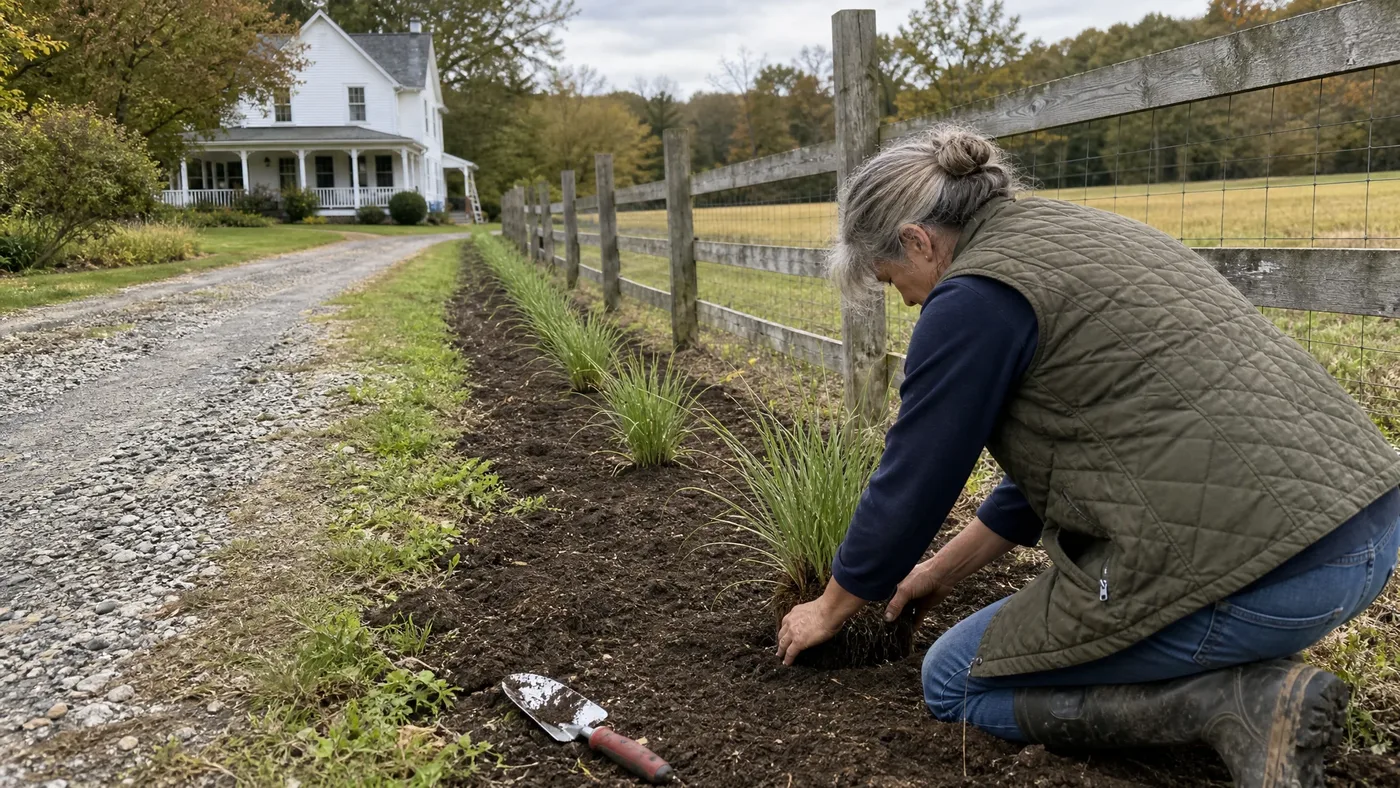
Plant these grasses wherever you like and they will sort themselves out. We believed that for years, right up until we strung a line along a measured fence and watched what 'Gracillimus' did with the room we gave it.
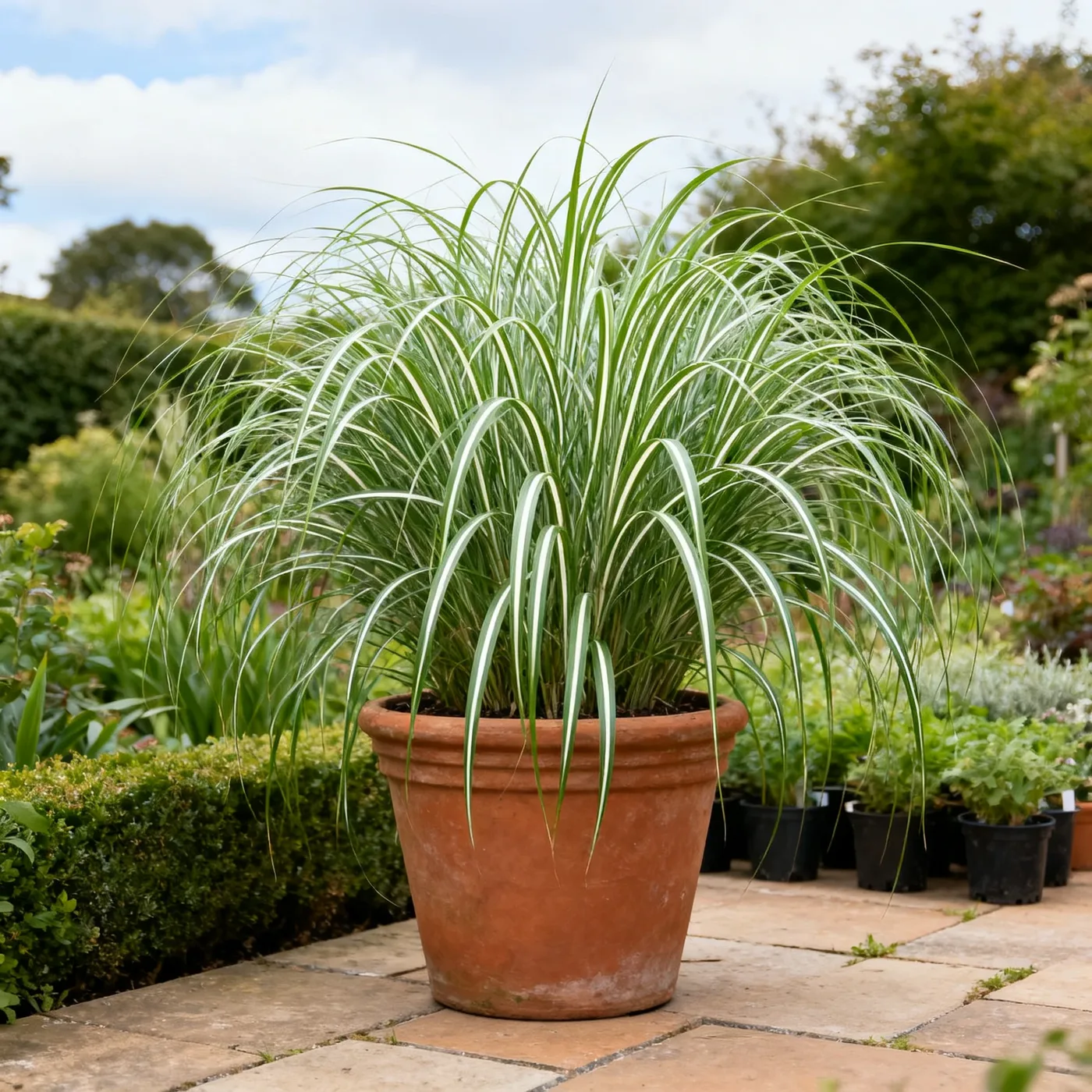
It sorted itself out, all right. Plants with room made tall, arching fountains. Plants jammed against a neighbor leaned, thinned in the middle and never looked right again.
Below, you'll find out all about Chinese Silver Grass spacing, including whether the three-foot rule holds up, a worked 30-foot fence line planted two ways, how a privacy screen changes the math, numbers for single specimens and mass plantings, and what the row looks like in year three.
Is the Three-Foot Rule True for Chinese Silver Grass?
Tags and forums repeat "plant three feet apart." Check it against the numbers before you dig, because the rule hides a trade-off.
What the Sources Say
Start with the published figures, then do the arithmetic yourself.
UF/IFAS gives the species a plant spacing of 36 to 60 inches, which is 3 to 5 feet. That range covers every Miscanthus sinensis, compact selections included. 'Gracillimus' is not compact. It spreads 5 to 10 feet, while NC State puts the species as a whole at 4 to 6 feet wide.
Even at the low end of 5 feet, a clump planted 3 feet from its neighbor overlaps it by 2 feet. At 4 feet it overlaps by 1. No spacing keeps these clumps apart at maturity, so the real question is how much overlap you want.
Our Verdict
Here is the call, so you can stop reading forum threads.
Three feet is true as a floor and misleading as a default. For one full-size cultivar the answer is a range of 3 to 5 feet. The wide ranges you see online apply to the cultivar too, so don't ignore them.
Borders and hedges use the same number. A border is one row in front of a fence or bed, and a hedge is that row left to merge. Only your tolerance for overlap changes.
The choice inside the range depends on what you want in the first few years, not at maturity. The sections below run both options on the same fence. If you want the size side first, read our size and growth rate guide.
Measuring a 30-Foot Run for Chinese Silver Grass
Our example is a straight 30-foot fence line in full sun, which is what this cultivar wants. Measure it first, because every count after this depends on it.
Mark the Row
Do this with string and stakes before any plant comes out of its pot.
- Stake both ends of the run and pull a string between them. Check the length. Ours is 30 feet.
- Move the string out from the fence. Half of the 5-foot minimum spread is 2.5 feet, so set the planting line at least that far from the boards. Plants at the wide end of the range will lean on the fence anyway.
- Walk the line at midday. Fence shadow can leave one end short of sun, and the cultivar wants full sun.
- Confirm your zone. This cultivar is hardy in zones 6 through 9, while the species sheet runs down to zone 4, so do not borrow the species range.
The clumps have very short rhizomes and do not run, so you do not need an edging barrier along the fence. The row stays where you put it.
Check the Ground Along the Fence
This cultivar is easygoing about soil, so the check takes a minute.
Fence lines often have compacted builder's fill near the posts. Push a spade in every few feet. If it will not go in, loosen the planting strip before you set anything. Our planting guide covers the hole itself.
Choose the End Points
Run ends decide whether the row looks finished or chopped off.
Keep your last plant between half a spacing and a full spacing from each end. If the run stops at a gate, leave the full spacing so the grass never blocks the swing. If it runs on into another bed, half a spacing is plenty. Your plant count sets the exact margin, as the next two sections show.
Three Feet Apart Means Ten Plants and Tight Years
Here is the tight option, run from stake to stake on the 30-foot line.
The Count and the Cost
The count comes first, since cost follows from it.
Put the first stake 1.5 feet from one end, then every 3 feet after that. That gives ten plants, the last one 1.5 feet from the far end. Your cost is ten times the per-plant price at the container size you choose, so a bigger pot multiplies fast. Our container size guide helps you weigh that price.
How Fast It Closes
Fast, relative to the alternative.
This grass is clump-forming with very short, inconspicuous rhizomes, so it never runs sideways to fill a gap. A gap closes only when a clump widens. At 3 feet, each clump has less distance to cover before it touches the next.
That matters because the cultivar grows fast, against medium growth for the species. Tight spacing makes the row look like a hedge sooner.
The Price You Pay Later
Closeness has a bill attached.
Three- and four-year-old plants tend to flop and may thin in the center. Clumps with 2 feet of overlap compete for the same ground sooner, so they reach that stage with less room to recover. Expect to divide earlier, and expect to do it on ten plants.
Verdict. Choose three feet if you want a wall quickly and accept more upkeep down the line. It is a fair deal, but it is a deal.
Four Feet Apart Changes the Count and the Gaps
Now the same fence at 4 feet, which sits in the middle of the 3 to 5 foot range and costs you three fewer plants.
Seven plants span 24 feet, so center them with 3 feet left at each end. Eight plants at 4 feet would need 28 feet of spread and leave only 1 foot at each end, which looks cramped at a fence corner.
Customers usually ask us whether they can squeeze in an eighth plant. You can, but you land at about 3.4 feet apart, and most of the savings over the tight option vanish.
The table sets the two options side by side on the 30-foot run.
| Option | Plants | End margin | Overlap at 5-foot spread | Bare soil early on |
|---|---|---|---|---|
| 3 feet apart | 10 | 1.5 feet | 2 feet | Less, closes sooner |
| 4 feet apart | 7 | 3 feet | 1 foot | More, closes later |
What the Gaps Look Like
Expect to see soil between the clumps for the first seasons.
Mulch it and leave it alone, because these grasses do not creep to fill space. The gaps close as each clump widens toward the 5-foot minimum, so they close later than at 3 feet. If bare soil bothers you, plant low perennials in the gaps and pull them out as the grass takes over.
What You Get Back
The wider spacing pays off in the long run.
Each clump has more ground, so it holds an upright fountain shape longer before the center opens up. You buy fewer plants and divide fewer clumps. The cost is patience in the early years.
When Chinese Silver Grass Becomes a Privacy Screen
A screen asks more of the plant than a border does, and this grass has limits you should know before you promise yourself privacy.
Height Is Fixed, Density Is Yours
Height is set by the plant, so spacing cannot help there.
The cultivar reaches 5 to 6 feet, while its upright habit can reach 5 to 8 feet. That blocks a patio view from a seat. It will not hide a second-story window or rise far above a 6-foot fence.
You cannot buy extra height with closer spacing. Spacing controls density only. If you need more height on day one, start with a larger container, not more plants.
Choose Density Wisely
Closer spacing makes a solid screen sooner. Wider spacing leaves see-through gaps for the first seasons.
Our advice is to stay at 4 feet for the whole run and use bigger plants. Reserve 3 feet for the one stretch that faces the window or the neighbor's deck. For a thicker screen, add a second row behind the first, offset so each plant sits between two in front, about 3.5 feet back.
Why the Screen Lasts Through Winter
This grass keeps working after the leaves dry.
The foliage stands through winter, so the screen persists as dry stems until you cut it. Pink flowers arrive in late summer and fall, adding to the effect. Timing is in when and how to cut back Chinese Silver Grass.
Adjusting for a Single Specimen and a Mass Planting
The 30-foot row is one case. These two adjustments cover the other common ones.
One Plant on Its Own
A lone clump needs a different rule from a row.
Maiden grass is frequently used as a specimen or screen. A lone clump has no neighbor to lean on, so give it its full width. Plant at least 2.5 feet from any wall, walkway or bed edge, which is half the minimum spread. Give it more if you want the fountain shape intact, since the upper end of the spread range is 10 feet.
A Big Block of Plants
Mass plantings follow the 4-foot number, with one twist.
The grass also works in group plantings, forming a mass of fine-textured foliage, especially near a water garden or pond. Use 4 feet and stagger the rows so each plant sits between two in the row behind it. A staggered 4-foot grid takes roughly 14 square feet per plant, so a 100-square-foot bed holds about seven.
Skip the 3-foot version in a mass. Once a block closes, you cannot reach the middle clumps to divide them.
What Year Three Looks Like for Chinese Silver Grass
Three growing seasons is where the plan meets the plant. Here is what to check on the 30-foot row.
The 4-Foot Row
This is the row that should be hitting its stride.
Expect the clumps to touch or just overlap, and the line to read as one planting rather than seven. Any remaining gaps should be small. If a gap still bothers you, it is cosmetic, and the next season will narrow it.
The 3-Foot Row
This row will have looked finished earlier, but year three is when to watch the centers.
In our rows, the tightest plantings are usually the first to open up in the middle. That fits the tendency of three- and four-year-old plants to flop and thin. The fix is the same either way. Divide in spring, or cut back harder, to encourage upright growth. Our division guide walks through it.
When to Leave It Alone
Resist the urge to rearrange a healthy row.
Do not respace a row because it looks full. Full is the goal. Respace only when the centers die back or the clumps lean over. The grass is quite drought tolerant and rust often goes away in drier weather, so a settled row asks for very little else.
A Spacing Plan Worth Staking the Season On
The three-foot rule is a floor, not a plan. For a full-size cultivar with a spread of 5 to 10 feet, 4 feet is the number we stand behind for borders, hedges and screens. It buys you fewer plants, less dividing and a row that holds its shape longer. Choose 3 feet only for a stretch that needs privacy fast. Copy this for a 30-foot run: 7 plants, 4 feet apart center to center, 3 feet from each end.
Chinese Silver Grass
Nursery-grown Chinese Silver Grass in sizes from 1 Gallon, shipped to your door.
From $33.97
Shop Now →Before a plant leaves us, our growers go over its crown, roots and foliage by hand. We grow and sell top-quality grasses on our own farms, so each clump in that 30-foot row has been checked by the same people who raised it.